February 19, 2012

5.1 Glasshouses

5.1 describe how glasshouses and polythene tunnels can be used to increase the yield of certain crops


Both Glasshouses (a.k.a. greenhouses) and Polythene tunnels aim to have the same effect on plants: provide warmth for plants to grow in a humid environment.
How they work

  1. Heat enters the greenhouse from the sun (in short IR waves)
  2. The surfaces in the greenhouse absorb the short waves and reemit this energy as heat
  3. The heat warms the air inside the greenhouse
  4. Most of the heat is reflected back into the greenhouse and doesn't escape


This increases crop yield because…

  • … Warmer temperatures allow enzyme reactions to occur more efficiently
  • … Less water is lost to the environment
  • … Constant temperature around the year
Polythene tunnels are also used to the same effect but are cheaper, easier to move and easier to use for farmers because they can be placed over rows of plants to protect from the frost as in a greenhouse plants must be potted.


2.89 Hormones

2.89 understand the sources, roles and effects of the following hormones: ADH, adrenaline, insulin, testosterone, progesterone and oestrogen.

Endocrine glands, produce chemical signals known as hormones, these travel through the blood stream from an endocrine gland to a target tissue where is has an effect.

  • ADH/antidiuretic hormone – from the Pituitary gland – Target: collecting duct – increases absorption of water into the blood
  • Adrenaline – Adrenal glands (on top of kidney) – Heart (many others) – increase Heart Rate
  • Insulin – Pancreas – Liver – Storage of glucose (reduce blood sugar levels)
  • Glucagon (opposite of Insulin) – Pancreas – Liver – Puts sugar into blood stream
  • Testosterone – Testes (low levels in women, produced in ovaries) – Testes (sperm cells) – Sperm cells mature
  • Progesterone – Ovary – Uterus lining – maintain uterus lining
  • Oestrogen – Ovary – Lining of the Uterus – Build up the lining of the uterus

2.88 Temperature regulation

2.88 describe the role of the skin in temperature regulation, with reference to sweating, vasoconstriction and vasodilation

Stimulus: Temperature of internal body temperature (blood temp)
Receptor: Hypothalamus (as blood flows through this part of the brain)
Coordinator: Hypothalamus (the part of the brain associated with thermoregulation)
Effector: Skin
Responses:

Cooling down

  • Sweat glands produce sweat which evaporates from the body creating a cooling effect.
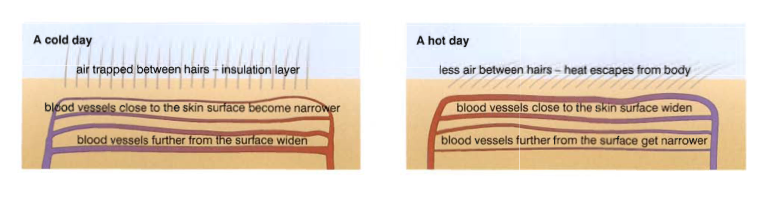
  • Vasodilation - Blood flows to the surface of the skin through dilated vessels so that heat can potentially radiate off of the body.
  • Furthermore the radiating heat from the blood increases the evaporation of sweat, this is known as latent heat of evaporation.
Heating up

  • Vasoconstriction - Capillaries near the surface of the skin narrow to keep heat inside of the body
  • Shivering – a reflex to increase body temperature, muscles groups near vital organs shake in an attempt to create warmth.
  • Hair erection – hair stands up to trap a layer of air close to the skin. (air is a poor conductor of heat)

2.87 Eyes’ response to Stimuli

2.87 understand the function of the eye in focusing near and distant objects, and in responding to changes in light intensity

Focusing
Most of the bending of light is done by the Cornea
The Lens bends rays slightly to make an image clear and sharp
To focus on far objects the rays entering the eyes are almost parallel so less bending is required. The ciliary muscles relax tightening the suspensory ligaments so the lens is thin to focus the object on the retina
To focus on near objects, the rays are highly diverged so the cilary muscles contract, slackening the suspensory ligaments causing the lens to fatten focusing the light onto the retina
Light Intensity
The amount of light that enters the eye is controlled by the Iris this is done by changing the pupil size. The iris contains circular and radial muscles
In bright light
Circular muscles contract, radial muscles relax. Making the pupil smaller so less light can enter the eye. (Too much light can damage)
In Dim light
Circular muscles relax, Radial muscles contract. Making the pupil bigger to let more light into the eye.


February 6, 2012

2.86 The Eye

2.86 describe the structure and function of the eye as a receptor

The eye is a photoreceptor that detects changes in visible light. When light stimulates the rods in the back of your eye a nerve impulse is sent to the brain along the optic nerve, your brain then interprets these impulses to make a picture.

  • Ciliary muscles – Contract or relax to alter the shape of the lens (to focus)
  • Cornea – Transparent cover allows light in and does most of the bending of light.
  • Iris – Alters pupil size (to vary light intake)
  • Vitreous Humour – Clear jelly that gives the eye ball shape
  • Lens – changes shape to focus light on the retina
  • Retina – Contains the light-sensitive receptor cells which change light into electrical impulses
    • Rods – sensitive in dim light but only sense black and white
    • Cones – sensitive in bright light and can detect colours
  • Sclera – Protective tough outer layer of the eye
  • Suspensory ligaments – Hold the lens in place
  • Optic nerve – Carries the electrical impulses to the brain
The Gif below shows the human eye dilating due to a change in light intake this is controlled by the Iris


January 28, 2012

2.85 Reflexes

2.85 describe the structure and functioning of a simple reflex arc illustrated by the withdrawal of a finger from a hot object

In some cases the response to a stimulus is always the same and needs to be applied quickly in order to not damage the body. In order to reduce reaction time the brain is removed from the process such that the impulse travels up the sensory nerve through a small relay nerve in the spinal cord that connects directly to the motor nerves so the reflex response can take place.
Nevertheless it is important to note that the receptor does still relay the impulses to the brain so that we are aware that we have touched a hot/sharp object (for example) and this creates the response of us saying “ouch” but this is significantly later than the reflex response... The reason reflex responses work is because the decision and response is always the same.

2.84 Responses

2.84 understand that stimulation of receptors in the sense organs sends electrical impulses along nerves into and out of the central nervous system, resulting in rapid responses.

Impulses from our sensory organs are passed from the receptor to the coordinator (CNS) by sensory nerves. The impulse is then passed up the spinal cord to the brain where the brain generates a response and sends impulses back down the spinal cord through motor nerves which create the response.
For example if the eyes saw a red pen the co-ordinator (the brain) could decide “I like red; pick up the pen” this signal will be sent back down the spine through a motor nerve in the arm where the effectors (arm muscles) pick up the pen. It is important to note that all of this takes place reasonably fast but can be sped up by removing the interaction of the brain…[see 2.85]